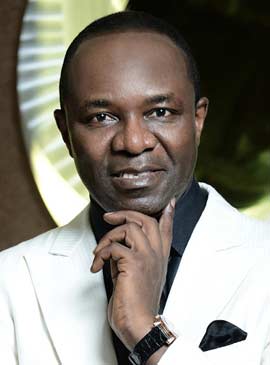
Minister of State for Petroleum Resources, Dr. Ibe Kachikwu, yesterday, disclosed that the Federal Government has reached a $5 billion settlement agreement with five International Oil Companies, IOCs, over debts owed the companies between 2010 and 2015.
The deal will see Nigeria saving over $1 billion, as it is believed that the oil companies are being owed over $6 billion. Though the Nigerian National Petroleum Corporation, NNPC, had repeatedly queried the amounts it owes the western companies, the settlement is an attempt to draw a line under the dispute. In an interview with Financial Times, Kachikwu stated that the companies — Royal Dutch Shell, ExxonMobil, Eni,Chevron and Total — would be paid the sum to cover outstanding joint exploration and production payments.
According to Kachikwu, the $5 billion payments will be made in the form of barrels of new crude production over the next five years. Furthermore, the report stated that the settlement also addressed the $1 billion debt the oil companies claimed was due from NNPC for costs incurred this year in the joint ventures. The oil companies, the report said, were expected to receive a one-off cash payment from the Federal Government to cover this amount. According to the report, the companies have already signed the deal, which is still subject to the approval of two regulatory agencies as well as President Muhammadu Buhari, while they also seek to forge new financing arrangements for their joint ventures in Nigeria. “The settlement had been accepted by the five companies. It is hoped the deal can be finalised before the end of the year,” Kachikwu said.
THE Federal Government is set to compel International Oil Companies (IOCs) to cut the cost of producing oil in Nigeria.
Minister of State for Petroleum Resources, Dr. Emmanuel Kachikwu, who confirmed the plan said at the present low price of crude oil, it makes economic sense to cut cost. Consequently, he stated that the cost, which the National Petroleum Policy put at $28.99 per barrel, would be reviewed downward with the IOCs in order to arrive at an acceptable cost. He stated: “The nation needs to review the current high cost of producing oil. It does not make sense to produce oil at such high cost, especially now that crude oil price has dropped from over $100 to $50 per barrel. “It will not make sense to produce at high cost anymore. We will sit with the IOCs to look at the cost elements in order to take a better decision. It is in the best interest of everyone to bring down the high cost of producing oil in Nigeria.” The National Petroleum Policy, gave a breakdown of the current production cost as follows: $8.81, $13.19, $4.11 and $2.95 as production costs, capital spending, gross taxes and admin/transport per barrel respectively. The policy which identified Nigeria as one of the most expensive oil provinces in the world, added that oil price has been very unstable in recent times. Kachikwu said further: “There has also been extreme volatility of oil and gas prices since around 2005, at levels not seen since the 1860s. Prices went down dramatically as US shale production took off. “Two clear messages for Nigeria are that it has to broaden the economy towards a gas based industrial economy; and within the oil sector, Nigeria has to move downstream into the value added sectors of refining and petrochemicals.”
The naira yesterday appreciated significantly in the parallel market and in the Investors and Exporters (I&W) window. At the close of business yesterday, the naira appreciated by N2 in the parallel market while it appreciated by N1.29 at the I&E window.
Data from the Financial Market Dealers Quote (FMDQ) showed that the indicative exchange rate for the window dropped yesterday to N366.59 per dollar from N367.88 per dollar on Monday. Also the parallel market exchange rate dropped to N363 per dollar yesterday from N365 per dollar on Monday. Vanguard investigation revealed that the naira appreciation in the parallel market is driven by low demand for dollars amidst sustained dollar supply to bureau de change subsector by the Central Bank of Nigeria (CBN).